 Fluirflowing toward fluency
Can You Read This B2 Spanish Short Story?
Listen to a full short story at B2 - no signup needed.
Fluir
La noche de las hogueras
5 min read · B2
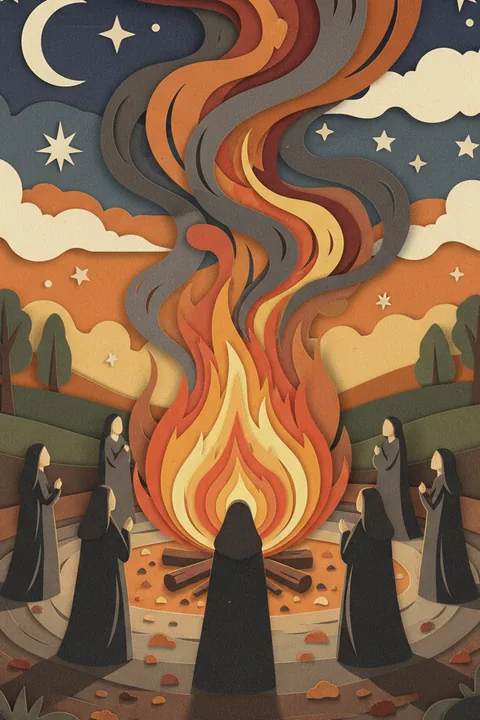
Cuando era niña, mi abuela me explicaba que la fiesta de San Juan tenía algo terapéutico: quemar lo viejo para empezar de nuevo. Cada año, en el vecindario donde crecí, los vecinos se reunían en la plaza para preparar la hoguera veraniega más grande que pudieran imaginar. Los hombres cargaban troncos y muebles rotos, las mujeres cocinaban durante horas, y los niños, enanos entre tanta gente, corríamos alrededor sin entender del todo el significado del ritual.
Aquel año, sin embargo, algo había cambiado. Mi abuela, que siempre había sido la encargada de encender el fuego con un mechero de hierro que había pertenecido a su padre, estaba enferma. El médico decía que su hígado ya no funcionaba como antes, que había entrado en una fase delicada. Ella, terca como siempre, insistía en que iría a la plaza aunque tuviera que ir en silla de ruedas.
—No me vas a describir cómo fue la fiesta este año —me dijo una tarde, mientras yo cocinaba a su lado—. Yo misma la voy a ver.
Mi madre y yo cooperamos para llevarla. Fue un pequeño operativo familiar: sillas plegables, mantas, y el termo de manzanilla que ella insistía en llevar aunque hiciera calor. El camino hasta la plaza, contado en pasos, no era largo, pero para ella, con las piernas cansadas, se convirtió en una pequeña aventura.
Cuando llegamos, la hoguera ya estaba montada, alta como una torre, con muñecos de paja que representaban, según la tradición local, todo lo malo del año: el pecador imaginario que cada vecino quería dejar atrás. Había un ambiente casi cinematográfico, con las llamas anaranjadas reflejándose en las caras de la gente y el humo subiendo hacia un cielo todavía claro por la hora veraniega.
—Antes esto era distinto —me dijo mi abuela, mientras yo la ayudaba a sentarse—. Había menos gente, pero más fe. La fiesta ha evolucionado, como todo. Ya no es lo mismo, pero tampoco es peor. Solo es diferente.
Le pregunté qué quería decir, y ella, con esa voz ronca característica de quien ha fumado y reído demasiado en la vida, empezó a contarme una historia que yo nunca había escuchado. Me habló de un antiguo culto politeísta que, mucho antes de que llegara el cristianismo a estas tierras, ya celebraba el solsticio con fuego. Decía que el catolicismo, y más tarde ciertas ramas del protestantismo en otras regiones de Europa, habían adaptado esas costumbres antiguas a sus propios calendarios religiosos, mezclando lo pagano con lo sagrado sin que nadie se diera cuenta del todo.
—Es curioso —añadió—, cómo las tradiciones se enredan unas con otras, como raíces bajo la tierra. Nadie sabe ya qué parte es de quién. Y no importa. Lo que importa es el fuego, y estar aquí, juntos.
Mientras hablaba, un grupo de jóvenes se acercó cargando un turno más de leña para alimentar la hoguera. Alguien había traído una guitarra, y pronto empezaron a sonar canciones que todos conocíamos de memoria, de esas que se cantan sin pensar, por pura costumbre familiar. Mi abuela cerró los ojos y sonrió, como si aquel calor le devolviera algo de energía.
De pronto empezó a llover. No fue una casualidad meteorológica cualquiera, sino esa lluvia repentina de verano que llega sin avisar y se va igual de rápido. La gente corrió a buscar refugio bajo los toldos cercanos, riendo, empapada hasta los huesos, mientras la hoguera seguía ardiendo, indiferente al agua, como si el fuego tuviera su propia voluntad.
—¡Qué reacción tan española! —bromeó mi madre, viendo cómo nadie parecía realmente molesto por la lluvia—. Nos mojamos y seguimos bailando.
Mi abuela, en cambio, no se movió de su silla. Se quedó mirando las llamas, con gotas de agua resbalando por su cara arrugada, y me dijo algo que nunca olvidaré:
—Retirar lo viejo no significa que no vaya a doler. Solo significa que hay que dejarlo ir de todas formas.
No supe entonces si hablaba de la fiesta, de su enfermedad, o de los años que ya no volverían. Quizá hablaba de las tres cosas a la vez. Pensé en el budismo, del que había leído algo en la universidad, cuando aún soñaba con doctorarme en antropología: esa idea de que todo es impermanente, que hay que aceptar el cambio como parte natural de la vida. Mi abuela nunca había leído sobre budismo, pero había llegado, a su manera, a la misma conclusión, después de setenta y tantos años de hogueras.
Murió cuatro meses después, en otoño, cuando ya no quedaba rastro del malestar veraniego ni de la lluvia de junio. Pero cada año, cuando llega San Juan, sigo yendo a la plaza con el mechero de hierro que ahora es mío, y enciendo la hoguera pensando en ella, en su voz ronca, en su manera tranquila de aceptar que todo, tarde o temprano, se transforma en otra cosa.
B2 fiction is where authorial voice starts to matter - sentence rhythm, tone, the kind of storytelling detail a graded textbook never bothers with. The stories on this page are written for readers who've cleared the intermediate plateau and want reading that's genuinely engaging, not just comprehensible.
Every article here is pitched to sit in your personal 90-98% comprehensible zone - the range where you understand almost everything from context, but still meet enough new words to grow. That's the comprehensible-input principle: reading slightly above your current level, not a graded textbook and not native-speed news, is what actually moves your vocabulary forward. Tap any unfamiliar word while you read and it's saved straight into your vocabulary graph - the same graph your flashcards and AI conversation practice draw from.
At B2 the aim shifts from "can I follow this" to "am I actually being stretched" - these stories sit close enough to your edge that new vocabulary keeps arriving without every sentence becoming a decoding exercise.
Stop freezing when it’s your turn to speak Spanish.
Speak to Lucía, your Spanish AI partner. She’s briefed on the words you’ve been reading, so you practise saying what you actually want to say.
No card to start · a free trial of the whole loop
Refresh
Flashcards from your own reading
Every card is a word or phrase you chose to save, never a generic deck. Each one keeps the real sentence where you first met it, and the ones you find hard come back sooner while the ones you already know come back less often.
Every card came from a word or phrase you saved
Flip it and answer honestly. Your answer sets when it comes back
Look up the full conjugation table, reference only. It never counts as a review
The one idea
One vocabulary graph. Every word flows through it.
You can save words new to you while reading articles and speaking to Lucía in voice notes. Flashcards then help you remember those words. And every word you save feeds back into the next article, the next card, the next conversation.
Read native Spanish, then tap to save new words.
Your saved words become the flashcards.
Say them aloud, and save new ones Lucía uses.
How you actually improve
Your level rises because your vocabulary does.
Fluir doesn’t quiz you up a ladder or hand out fake “level-up” badges. It grows the one thing that truly moves you from B1 to B2: the Spanish words you can recognise and say. It also quietly keeps everything you read at the exact difficulty where learning is fastest.
Vocabulary coverage of each level’s core Spanish, not a self-assessed score.
You’ll see something like “~4 months to B2 at your pace”, an honest example from the real in-app projection.
Every word compounds
Each saved word moves through your graph: met → known → said out loud. That growing vocabulary is your real level.
Tuned to you
As your vocabulary grows, Fluir serves articles you understand ~95% of, never too easy, never a wall. Difficulty rises with you, automatically.
Measured honestly
We track your coverage of the real CEFR vocabulary for each level (Instituto Cervantes, Cambridge) and show an honest pace that slows if you do. No inflated numbers.
Value first, always
The whole loop is free to try, no card.
No card at signup. No demo. Read a complete, narrated article and tap to save words, do a real round of flashcards built from those words, then spend a minute talking with Lucía. Feel the whole loop for yourself before you decide anything.
Start free, no cardHow we treat you
No streaks to protect. No mind games. Ever.
You’re a motivated adult, not a target for compulsion loops. Fluir is built to respect that.
Cancel in one tap
No “are you sure?”, no retention survey, no guilt. Leave whenever you like, and keep every word you saved.
Honest progress
Your “~7 months to C1” projection reflects real usage, and slows down honestly if you do. No inflated numbers.
Notifications with a reason
We only reach out on a real fact about your learning: cards actually due, a milestone actually hit. One a day, max. Opt-in.
Simple, honest pricing
Try the whole loop free. Then a free trial. Then one price.
Less than a single hour with a tutor: the whole stack, unified.
Annual
billed annually
- Everything in Monthly
- Billed once a year, no monthly renewals
- Cancel any time, keep your words
Monthly
Flexible. Cancel any time.
- Unlimited reading & flashcards
- 5 minutes of spoken conversation a day
- Full narrated articles
Reading and Refresh are always uncapped. Your free article, a round of flashcards, and a minute with Lucía come first, and the free trial starts only when you choose it.
Questions, answered
Before you start, the honest answers.
Why five minutes of speaking a day?
Because five minutes every day beats an hour once a week. Speaking is a habit before it is a skill, and short daily production is what builds it: five unbroken minutes of speaking Spanish out loud is genuinely hard work, and it is work you will actually do on a Tuesday evening.
It is a firm allowance, and it is part of what holds the price down. Both halves of the conversation count toward it, your speaking and Lucía’s replies, so it is five minutes of real exchange rather than five minutes of monologue.
Everything around it is uncapped. Read as much as you like: stories, dialogues, scenarios and opinion pieces, pitched at your level. Run as many flashcards as you want, every day. The speaking is the part with a number on it because it is the part that is hardest to get anywhere else.
My reading is miles ahead of my speaking. Does that break it?
No. It is the assumption the whole thing is built on.
Fluir tracks recognition and production separately, because they are separate. A word you save is met. A word you recognise reliably in flashcards, over at least three weeks, becomes known. It becomes said out loud only when you actually say it, correctly, in a spoken conversation. Typing it never counts, however right you are.
So the gap you are describing shows up on screen as a real gap, and closing it is the only thing the app is trying to do. Your reading level decides which articles you get. Your speaking is measured on its own terms, and it starts where it starts.
I freeze when I have to speak. What does the first minute actually look like?
Not “so, tell me about your weekend.”
Lucía starts by helping you build one sentence. She gives you a short meaning in English, you say the Spanish out loud, just three to eight words, and she adds a piece at a time until you have said something longer than you would have attempted cold. It is built from words you have saved, so you are not reaching for vocabulary you have never met. If you stall, “Stuck?” gives you hints one at a time: a nudge at the structure first, a partial sentence later, the actual form only at the end.
Then she takes a phrase from the sentence you just built and asks you something real with it, and you are in an actual conversation without having noticed the join. How much she holds your hand from there follows how you are actually doing: as your speaking gets stronger she speaks more naturally, corrects more lightly and prompts you less. If you have a hard day, the support comes back. It is not a level you unlock.
Corrections are capped at two per turn, and on spoken turns she is deliberately cautious: speech recognition mishears people, and being corrected for something you did not say is worse than a correction you did not get.
If speaking is genuinely impossible right now, you can type a turn instead. It is there as the exception, not a second mode.
Is talking to an AI really a substitute for talking to a person?
No, and she is not meant to be. A person notices things about you that a model does not, and being accountable to someone is its own kind of motivation.
What Lucía gives you is regularity. Speaking is the one skill you cannot build by consuming: you can read and listen for years and still freeze, because producing Spanish out loud, under a little time pressure, is a different act. There is nothing to book, no time to agree with anyone, and no hourly rate to weigh up before you open your mouth: she is there on the evening you have five minutes, and she does not mind you restarting the same sentence four times. If you already see a tutor, this is what makes those hours worth more.
Where does the reading come from? Is it real Spanish?
It is generated, and we would rather say so than let you assume there is a newsroom behind it.
Every article is written by a language model and then measured: a Spanish NLP pipeline scores its actual difficulty against the level it was written for, and anything outside that band is rejected and regenerated overnight. Nothing reaches you that failed its own difficulty check.
We never generate news: a generated article that reads like journalism will contain invented names, dates and figures, and that is a real harm rather than a rough edge. So it is fiction, dialogue, scenarios and opinion pieces, which carry no factual burden.
What if I miss a week?
Nothing happens. There is a small streak counter on your home screen, and if it goes back to zero, that is the whole of the consequence: no progress lost, no notification asking where you have been, nothing withheld until you return. It counts days. It is not holding anything of yours. The difference we care about is between having a counter and building a product around the fear of breaking one.
Your flashcards will have piled up, and we are not going to pretend otherwise: spaced repetition works by showing you things when they come due, so a week away means a bigger queue when you return. But nothing is deleted and nothing is marked failed. New cards are limited per day so the pile cannot run away from you, and everything genuinely due is shown rather than quietly trimmed to make the number look kinder.
Come back, do one round, read one story. The backlog comes down as you work through it, and none of it is designed to make you feel behind.
The words you save today are the words you’ll say tomorrow.
Start free: a narrated article, a round of flashcards, and a minute with Lucía. No card, no commitment: just the loop, working for you.
Start free, no cardFree to try · then a free trial· cancel in one tap